Why We See the Same Code Differently
Close your eyes. Try to visualize the largest, most complex repository you’ve ever worked on.
It’s difficult, isn’t it? You might see a flash of a specific directory, a gnarly dependency graph, or perhaps just that one legacy module everyone is afraid to touch. The sheer scale makes it impossible to hold the entire structure in your head at once.
But here is the fascinating part: If you ask three different people in your organization to describe that exact same codebase, you won’t just get three different descriptions. You will get three entirely different realities.
We don't memorize code; we build mental maps. We structure knowledge around the specific "altitude" we fly at. A backend developer needs the granular details of file architecture to do their job, whereas a stakeholder needs the high-level view of data flow.
But when those maps don't align, collaboration breaks down.
The Rashomon Effect of Software
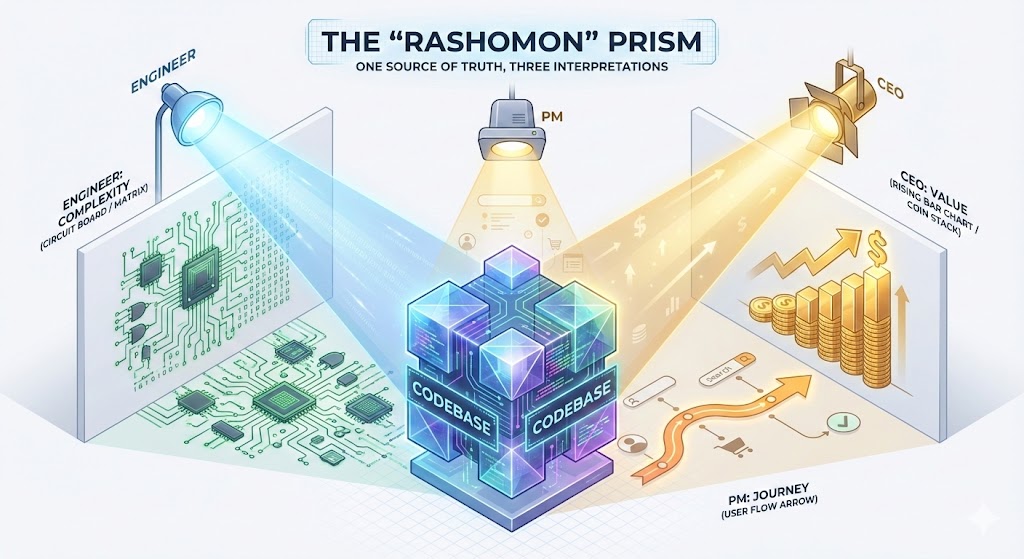
In cinema, the "Rashomon Effect" occurs when different witnesses describe the same event in contradictory ways. In software, we build internal maps based on our function.
While there are many nuances (and technical CEOs who love looking at raw SQL), we generally see three broad archetypes:
An engineer usually sees the system itself. Ask them about the codebase and they will picture the Auth service, its race conditions, and the layers of technical debt that have built up around it.
A product manager sees the user journey. They do not see payment_controller.rb; they see the checkout flow or the subscription upgrade path.
A CEO sees outcome. Their map follows the path from a user action to revenue, liability, or risk.
So, Who Is Right?
They all are.
There is no "wrong" way to visualize a repository. However, these disjointed perspectives create a massive hidden cost in every organization: The Translation Tax.
When a PM asks, "Why is the checkout flow broken?", and the Engineer answers, "Because the API gateway is timing out due to a circular dependency in the User model," they are speaking different languages. They are pointing at the same building but describing different floors.
The result is slower decisions, because meetings get stuck trying to agree on the state of the world before anyone can solve the problem. It creates blind spots around risk, because a "small UI change" can hide a major architectural refactor when the backend coupling is invisible. And it wears engineers down, because they end up translating technical constraints over and over for people who are looking at the same code through a different lens.
A Universal Control Plane
CodeBoarding eliminates the "Translation Tax" by creating a single source of truth that speaks everyone's language. We are building a control plane that connects raw code to the management tools your team already uses, like Linear, Jira, Slack, and GitHub.
Instead of forcing everyone into a single worldview, the goal is to let each person work at the level that makes sense for them.
For engineers, that means deep IDE integrations in VS Code, Cursor, and Windsurf, with real-time impact analysis that does not force you out of your editor.
For product owners, it means feature mapping through the web platform, so abstract product concepts can be tied back to code reality.
For leadership, it means a clearer view of engineering effort, debt, and risk without needing to interpret raw implementation details.
We are opening formal pilots with mid-market and enterprise teams now. If your organization builds complex software and feels this kind of misalignment, we would like to talk.